| Background
Albania, tightly closed to the outside world until the 1990s, has opened its doors and is racing to catch up. The energy level is high and AiP is working with one community to direct some of that energy toward saving their amazing architectural heritage and building their economy through heritage tourism. As one Albanian reporter recently revealed, development is ravaging cultural heritage as historic sites are flattened or transformed beyond recognition. AiP is returning to Gjirokastra to help assure that the race to move forward isn’t done at the expense of the past.
Gjirokastra grew up around a 13th century citadel, which still overlooks the town that is now comprised of a new lower town and an upper historic town. Ottoman rulers, who arrived in 1385 and resided in the town for over 500 years, directed the building of large stone tower houses (kullë houses) up the steep hillsides overlooking the Drinos river valley. Following the Ottomans’ departure, these massive houses were no longer maintained, with the inevitable result of hundreds of them descending into ruin over the past 100 years. Dozens more of these fascinating structures face a similar fate if action is not taken soon.
This workshop offers two tracks: a full day of conservation work each day or mornings spent in drawing class, followed by an afternoon working in a kullë house. Read on for more details.
Project
We will be working on a project developed by Cultural Heritage without Borders (CHwB), a Swedish international relief organization founded in 1995 and working to preserve endangered cultural monuments. Their aim is to integrate the preservation of cultural properties into their program of aid and development, because they believe - as does AiP - that preserving cultural heritage can help residents recover their sense of dignity and empowerment, increasing the likelihood of success in the fight against poverty.
Workshop participants will be working on the Babameto House, a Category I monument. Built at the end of the 19th century, this is one of the newer tower houses, and its restoration will serve as a model for the process of restoration and sustainable use.
Young Albanian professionals and youth from surrounding Balkan countries will work with international volunteers to learn hands-on skills needed to save the structures. That knowledge will then be used during an ongoing series of conservation projects planned for this historic stone city.
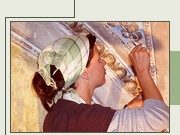
Volunteers’ hands-on work will include tasks such as re-setting stones; applying interior and exterior plaster; wood working such as hewing beams and relaying wooden floors; and refurbishing iron elements while learning about traditional techniques for producing iron nails and hinges.
AiP participants may choose between two tracks of activity. Participants may spend both morning and afternoon working on restoration of a tower house, or they may choose to devote the afternoon to restoration after spending the morning in a drawing class taught by one of Albania’s most talented artists, Albert Kasi.
Mr. Kasi, a native of Gjirokastra, is skilled in both drawing and sculpting and his work can be seen displayed in the lower town. His drawing class will be held at the Skendulati House, one of the town’s most beautiful and beautifully maintained tower houses.
Logistics
The City of Gjirokastra is located in southern Albania near the border with Greece. If flying to Albania, take a flight to Tirana International Airport in Rinas, 25 km from the capital city of Tirana. From here take a taxi into Tirana, and if arriving on Saturday, meet AiP participants at the Hotel California near the city center for a pleasant overnight stay. Sunday morning, participants will travel together by bus to Gjirokastra, approximately a five-hour drive.
The bus currently costs about US$12, but is subject to change. The cost of one night in Tirana is included in your workshop fee, but meals in Tirana and the bus to Gjirokastra are the responsibility of each individual. You may also choose to fly to Athens and take a connecting flight to Ioannina, a small town near the Albanian-Greek border. Private taxis are available to drive you across the border and on to Gjirokastra, approximately two hours away. This route may require a more adventurous spirit, as schedules sometime put you at the border after dark with non-English speaking drivers.
Residents of most countries will not need a visa to enter Albania and need only a valid passport. Be sure to check requirements for your country of origin. If a visa is needed, be sure to leave sufficient time for processing, approximately 2-4 months. Note that some people who may enter the country without a visa must pay an entry tax of approximately 10 Euros when leaving from the airport.
The workshop will be two weeks in length and participants may register for either one or two weeks. The cost is US$2150 for one week and US$3100 for two weeks, which covers lodging, meals, workshop materials, instruction, most fieldtrips and insurance. Transportation to the workshop is not included and is the responsibility of the participant. The fee for local residents not requiring lodging or meals is US$50 per week; with lunch the fee is US$75 per week. Several scholarships are available for participants from Albania and surrounding countries based on need.
Albania has a Mediterranean climate. The average daytime high in mid-September is 25 degrees C (77 degrees F), with cooler temperatures in the evenings. Please bring clothing that is suitable for the weather that will also be protective while working. Bring sturdy close-toed shoes for the work site, and be aware that you will often be walking on cobblestone streets. Please be conscious that safety is an important issue at any work site.
Workshop participants will be housed at the Kotoni Bed & Breakfast, which sits above the old city bazaar, and may check in on Sunday of the week they are attending. (Saturday night, September 18, 2010, is not included unless the participant is attending for both weeks.) Work hours at the site are generally Monday through Friday from 8:30-12:00 and 1:30-5:00. Meals will be provided at Kujtim's, where fresh local produce, fish and meat are turned into delicious cuisine by Kujtim and his wife Sylvana. Evenings and the weekend are free for exploring the area’s many beautiful sites.
Fieldtrips
Several fieldtrips are planned for the group during the two week period, including Butrint National Park, which boasts some of the greatest classical ruins in the Mediterranean. Butrint is located on a low promontory on the coast, and the site has been occupied since the 8th century BC. A second day trip will take participants to the site of Antigoneia, a very short-lived city with a history spanning just 150 years. It was founded by one of the most famous names of the ancient world, King Pyrrhus of Epirus (319-272 BC). His abilities during battle impressed Berenice, the wife of King Ptolemy of Egypt, who decided to offer him her daughter, Antigone, in marriage. In token of his gratitude he built Antigoneia. After a picnic lunch, there are a number of historic villages in the region to explore.
AiP will make arrangements for an optional weekend excursion to Berat; this cost is not included in the workshop fee. Berat is renowned for its great architecture and scenic beauty, and like Gjirokastra, is built on a steep landscape. The old Byzantine citadel that overlooks the river still contains a residential quarter within. The town also has a 15th century mosque and a number of churches of the Albanian Orthodox Church. Several of the churches house works by the renowned 16th century painter Onufri.
If you need additional information, please contact us at workshops@heritageconservation.net or call +1 303-444-0128.
If you find this project intriguing, but are unable to attend, you can still participate by supporting conservation work in Gjirokastra and at other project sites with a gift to AiP. Donations are tax deductible and will be used for a variety of needs – to provide participant scholarships, to purchase materials needed for conservation work, or to provide teaching materials for participants, just to name a few. We have partnered with Groundspring.org to make it easy and
safe for you to donate online:
If you would prefer to mail in a gift, please use our donation form.
|